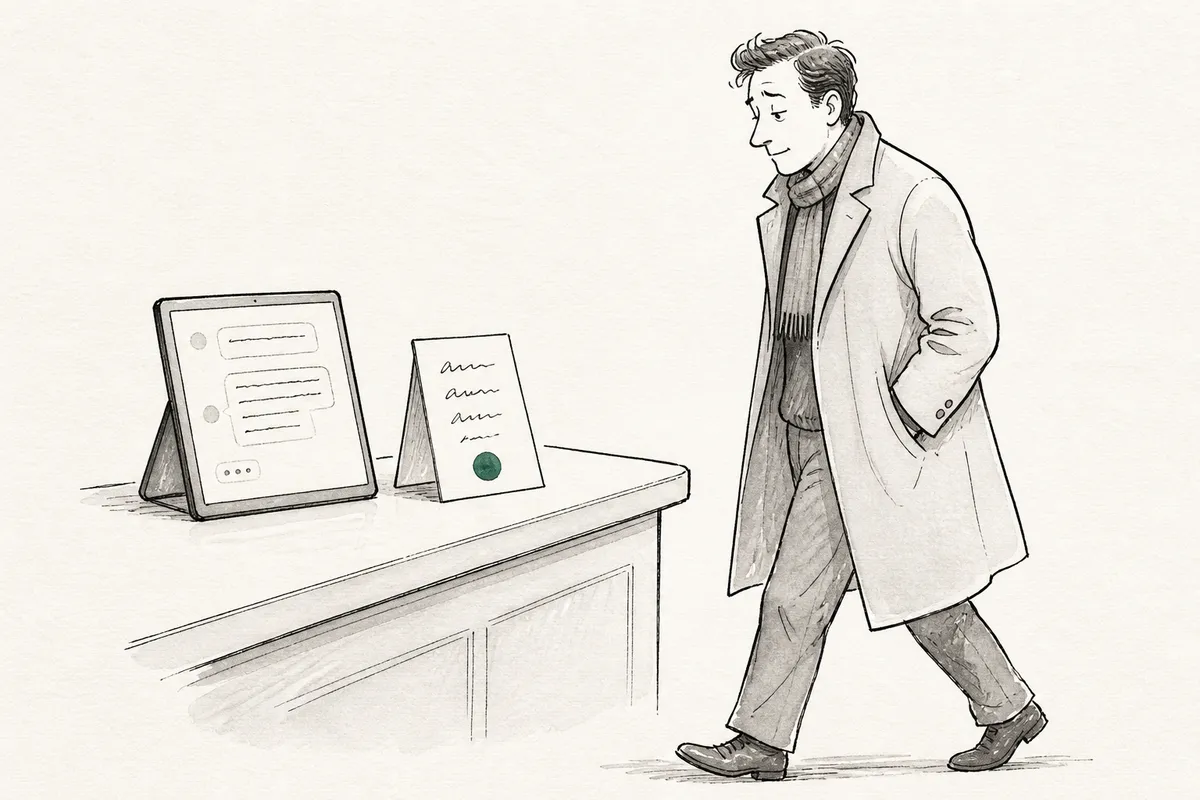
Should Customers Know They're Talking to AI?
There’s a particular kind of discomfort that shows up the moment a business has to decide whether to tell customers they’re talking to AI, and it doesn’t resolve itself just because the technology got good enough to pass as human. The question of AI disclosure customers actually care about isn’t really about the technology at all, it’s about what disclosure signals, and whether naming the thing out loud costs something or protects something. Owners tend to assume it’s a simple risk calculation, hide it and keep the interaction smooth, or reveal it and brace for backlash. That’s not quite how it plays out.
AI disclosure customers respond to means telling a customer, plainly and without qualification, that they are interacting with an automated system rather than a person. It can happen through a chat window label, a scripted line at the start of a call, or a simple statement embedded in the first response. The mechanics are easy. The discomfort is in deciding whether doing it helps or hurts, and most owners go into that decision assuming the worst case before they’ve actually tested it.
Why This Question Feels Riskier Than It Is
The fear behind hiding AI involvement usually isn’t about deception, it’s about momentum, the worry that the second a customer knows they’re not talking to a person, the whole interaction loses its warmth and the sale or the resolution slips away. That fear is reasonable on its face, nobody wants to hand a customer a reason to disengage. But the fear is built on an assumption that’s rarely tested directly, which is that disclosure reads as a downgrade rather than as information.
The absence of a complaint gets mistaken for the absence of a problem.
That’s the trap with disclosure decisions made in silence. A business that never discloses doesn’t get complaints about non-disclosure, because customers who feel misled rarely file a formal objection, they just quietly trust the business less the next time. That erosion quietly doesn’t show up as revenue on any single day. It shows up later, as hesitation, as shorter interactions, as customers who double check things they used to take at face value.
What Businesses Actually Fear, And What Some Have Found Instead
Here’s the honest version of the fear: owners worry that saying “this is an AI” out loud makes the business look cheap, understaffed, or like it’s cutting corners on the human touch customers expect. That worry isn’t irrational, plenty of service businesses built their whole reputation on personal attention, and admitting a machine is doing some of that work can feel like undercutting the brand. Some businesses hold that line hard, choosing to blend AI responses so seamlessly that no one thinks to ask.
Others have found the opposite. A plainly labeled AI interaction, one that says clearly what it is and what it can and can’t do, tends to lower a customer’s guard rather than raise it, because the customer isn’t left guessing whether they’re being handled by something pretending to be a person. That’s the entire insight. People don’t resent tools. They resent being unsure whether they’re dealing with a tool or a person and getting the answer wrong.
Here’s The Real Question Underneath The Fear
The real question isn’t whether disclosure costs trust, it’s whether the business is confident enough in what the AI actually does well to say so plainly, without hedging or apologizing for it. A business that’s unsure whether its AI system holds up under scrutiny will naturally want to hide it, because disclosure invites the customer to judge the interaction on its merits. A business that’s tested and refined that system has less to fear from naming it, because the quality speaks for itself once it’s out in the open.
That distinction matters more than most owners expect going in. Disclosure isn’t a trust problem by itself, it’s a mirror. It reflects back how much confidence the business actually has in what it built.
Documenting Before Automating, Clarifying Before Scaling
A pattern shows up across businesses that get this right, and it isn’t about clever wording on a disclosure banner. It’s about sequence, documenting before automating, clarifying before scaling, meaning the business figured out exactly what the AI should handle and what it shouldn’t before it ever went live in front of customers. That groundwork is what makes disclosure feel safe later.
- Define what the AI is actually responsible for, not a vague “customer service,” but specific tasks like scheduling, basic FAQs, or intake triage.
- Write down where the AI hands off to a person, and make that handoff visible to the customer, not buried.
- Test the disclosure language itself, plain and short reads better than a long legal-sounding disclaimer.
- Watch for the moments customers push back or ask “is this a bot,” and treat that as data, not an emergency.
| Approach | What it protects | What it risks |
|---|---|---|
| Full disclosure, upfront | Long-term trust, clear expectations | Slight friction at first contact |
| No disclosure, blended AI | Short-term smoothness | Erosion of trust if customer figures it out later |
| Disclosure only on request | Avoids awkward opener | Feels evasive once customer notices the gap |
That’s the trap with the middle option especially, disclosure only on request feels like a compromise, but it usually reads to customers as something being withheld until they caught it, which does more damage than either of the cleaner options.
Staying Level When The Pressure Is Real
The instinct to hide AI involvement tends to spike hardest right when the stakes feel highest, a frustrated customer, a complicated request, a moment where the business worries that admitting “this is automated” will tip someone over the edge. Staying level when the pressure is real matters more in exactly those moments than in the easy ones, because that’s when a customer is watching closely for whether the business is being straight with them.
Nobody sees the disclosure policy. They just notice whether the interaction feels steady or not.
That’s the part that gets missed in most of these debates. Customers rarely evaluate a disclosure statement on its wording. They evaluate the whole interaction for whether it holds together, whether the AI (once named) actually does what it claims, whether the handoff to a human happens cleanly when it’s supposed to. I’ve spent enough time cleaning up messes like that to know the wording matters less than the follow-through.
Fun Fact
Voice assistants and chatbots have been part of everyday customer service since long before generative AI made the interactions feel convincingly human, which means the disclosure question isn’t new, it’s just gotten harder to dodge now that the line between automated and human responses has blurred enough that customers can’t always tell without being told.
Field Note
Systems thinking treats disclosure not as a marketing decision but as a feedback loop question, meaning the value of telling a customer the truth about who or what they’re talking to lies in whether that information lets the customer calibrate their expectations correctly. A system that hides its own nature breaks that loop, because the customer can’t accurately judge the quality of the interaction against what it actually is. Named clearly, the loop stays intact, the customer knows what they’re evaluating, and any friction that shows up gets attributed correctly instead of misfiled as “bad service” when it was really “unclear service.”
FAQs
Do customers actually care if they’re talking to AI?
Yes, customers consistently want to know whether they’re interacting with AI or a person, because it changes how they calibrate trust, patience, and the kind of answers they expect to get. The concern isn’t usually about AI itself, it’s about being misled regarding what they’re dealing with, which shapes how forgiving they are of mistakes or limitations in the interaction.
Does disclosing AI use hurt sales or conversions?
Not inherently, disclosure only hurts conversions when the AI system underneath it isn’t good enough to justify the confidence of naming it plainly. A well built AI interaction that’s clearly labeled tends to perform fine, because customers respond more to whether their problem gets solved than to the label itself, as long as the label isn’t hiding a weak experience.
What is the best way to disclose AI to customers?
The best disclosure is short, plain, and stated upfront, something like a single line at the start of a chat or call that says the interaction is automated and explains how to reach a person if needed. Long disclaimers or legal-sounding language tend to create more suspicion than a short, direct statement does, because brevity reads as confidence rather than concealment.
Is it legally required to disclose AI use to customers?
Requirements vary by location and industry, and some jurisdictions have started introducing rules around AI disclosure in customer-facing interactions, particularly in regulated sectors like finance and healthcare. Businesses should treat this as a moving regulatory area rather than a fixed rule, and check requirements specific to their location and industry rather than assuming disclosure is optional everywhere.
How do I know if my AI system is ready for disclosure?
An AI system is ready for disclosure when it’s been documented, tested against real customer scenarios, and has a clear handoff point to a human for anything outside its scope. If the system still produces inconsistent answers or has no clean escalation path, the fix is improving the system, not hiding the fact that it exists.
What’s the risk of not disclosing AI to customers?
The main risk is trust erosion that shows up gradually rather than as a single complaint, since customers who discover they were misled tend to disengage quietly rather than confront the business directly. Over time that quiet disengagement affects repeat business and referrals in ways that are hard to trace back to the original decision.
Next Steps
Weighing whether to disclose AI involvement to customers isn’t a decision to make on instinct alone, it’s worth running your own version of this math against what your AI system actually does, how well it holds up, and what your customers are likely to notice either way. If you’re weighing this decision for your own business, talk it through on a discovery call at https://connect.greatlakesbusinesssupport.com/widget/booking/SR4YHWiGhQp2GVlUzQW4.