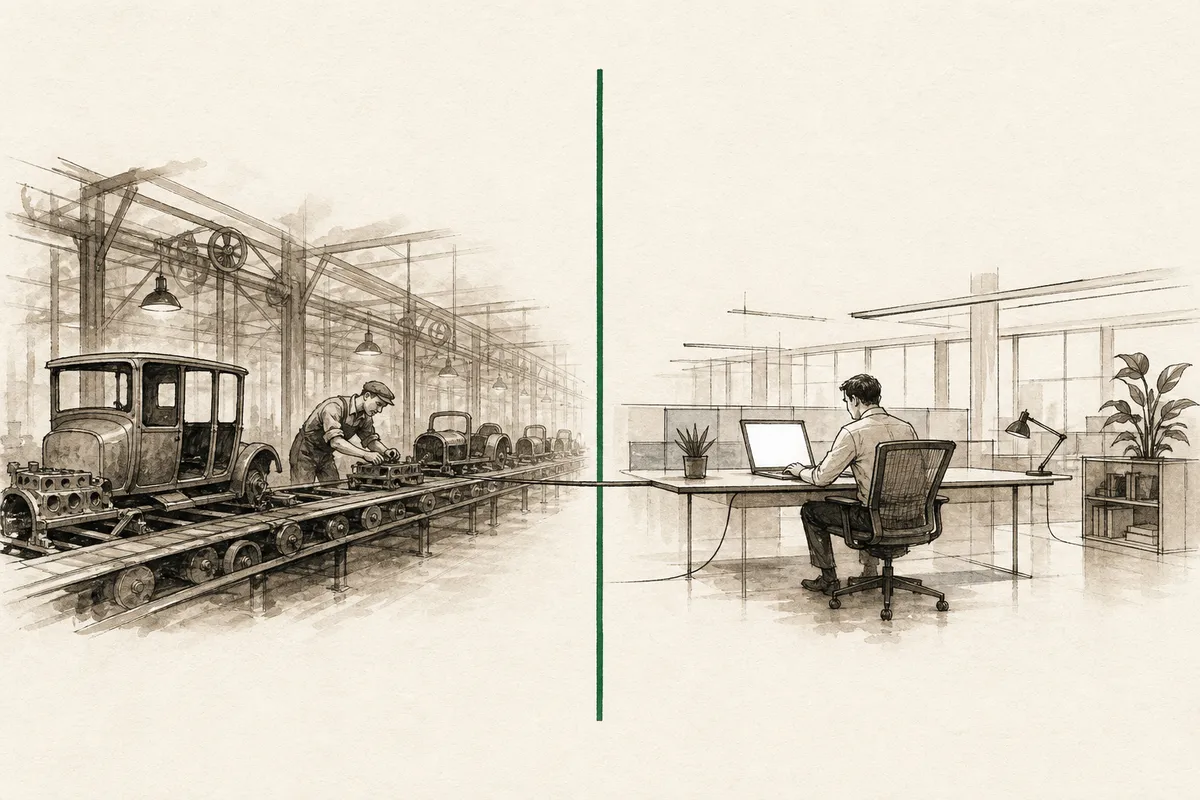
What the Ford Assembly Line Teaches Us About AI
TL;DR
An assembly line AI adoption comparison works because both technologies spread the same way, fast where the process was already documented and clear, slow where the work stayed tangled up in judgment calls and undocumented habit, and that pattern predicts who adopts AI easily right now. The assembly line didn’t succeed because Henry Ford was smarter than his competitors, it succeeded because the work had already been broken into steps that could be measured, sequenced, and repeated. That’s the entire insight. AI adoption is following the same fault line today, and the businesses that already know their own process will move through it faster than the ones that don’t.
Key Takeaways
- The assembly line spread unevenly across industries because the underlying work had to be documented and sequenced before it could be mechanized at all.
- AI adoption is following a similar uneven path, spreading fastest in businesses that already understand their own workflows and slowest in businesses that run on undocumented judgment.
- Resistance to a new technology often has less to do with the technology and more to do with how well the existing process is understood.
- Clarifying a process before automating it prevents a business from scaling a mess instead of scaling a system.
- The absence of a complaint about a slow or manual process gets mistaken for the absence of a problem, which delays adoption long after it would have paid off.
- Businesses that document their processes now are running the same math that early assembly line adopters ran, just with a different tool.
What Is the Assembly Line AI Adoption Comparison?
The assembly line AI adoption comparison is the idea that AI is spreading through industries the same uneven way the moving assembly line spread through manufacturing in the early twentieth century, quickly in operations with clear repeatable steps and slowly in operations still run on tacit knowledge. Ford’s Highland Park plant introduced the moving assembly line in 1913, and the change didn’t happen because someone invented a machine, it happened because someone finally documented the sequence of tasks that had been done ad hoc for years. That’s the honest version of what “innovation” usually looks like. It’s less about a new tool arriving and more about an old process finally getting written down clearly enough that a tool could touch it at all.
The comparison matters right now because AI is running into the same wall the assembly line ran into a century ago, businesses that already know their own workflow can hand pieces of it to a system, while businesses that don’t know their own workflow have nothing stable to hand off. That’s the real question underneath all the AI hype. Not whether the technology works, but whether the business asking about it actually understands what it’s asking the technology to do.
Why Did the Assembly Line Spread Unevenly Across Industries?
The assembly line spread unevenly because it depended on a precondition most industries didn’t have yet, which was a workflow broken into small, measurable, sequential steps, and industries that lacked that precondition couldn’t adopt the method no matter how much they wanted the efficiency gains. Manufacturing environments that had already standardized parts and tasks picked it up within a decade. Craft-based industries, where the value came from a single worker’s judgment across an entire product, resisted for much longer, and some never fully converted at all. The lag wasn’t stubbornness for its own sake, it was a structural mismatch between how the work actually happened and what the new method required.
The assembly line didn’t create process discipline, it exposed which industries already had it and which ones didn’t.
That’s the trap a lot of adoption timelines fall into. People assume the slow adopters were behind because they were resistant to change, when the real story is usually that their work hadn’t been documented well enough yet to change.
How Does This Compare to AI Adoption Today?
AI adoption today shows the same split, businesses with clearly documented processes are handing discrete tasks to AI systems within months, while businesses running on tribal knowledge and undocumented judgment calls are stuck because there’s nothing stable enough yet to automate. This isn’t a hypothetical or a sales pitch dressed up as math, it’s the same structural pattern the assembly line revealed, just running on a faster clock. A business that can write down exactly how it handles intake, follow-up, and scheduling has something an AI tool can actually work with. A business where that entire process lives in one person’s head has nothing to hand off yet, no matter how good the tool is.
| Factor | Assembly Line Era | AI Era |
|---|---|---|
| Precondition for adoption | Tasks broken into measurable steps | Processes documented and repeatable |
| Fast adopters | Standardized manufacturing | Businesses with clear workflows |
| Slow adopters | Craft-based, judgment-heavy trades | Businesses run on tribal knowledge |
| What adoption exposed | Which factories already had process discipline | Which businesses already understood their own operations |
| Real bottleneck | Mechanizing undocumented work | Automating undocumented decisions |
Here’s the honest version of what this table is really saying. The tool is rarely the bottleneck, documenting before automating is, and that was true in 1913 and it’s true now.
Why Do Some Businesses Resist AI Longer Than Others?
Some businesses resist AI longer because their operations run on unwritten judgment that feels efficient day to day, so the absence of a complaint gets mistaken for the absence of a problem, and nobody feels urgency to document what already seems to be working. That’s uncomfortable at first. A process can be slow, inconsistent, and dependent on one overworked person without ever generating a formal complaint, because customers rarely say “your intake process wasted twenty minutes,” they just quietly go somewhere else. The cost quietly doesn’t show up as revenue lost, it shows up as revenue that never arrived, which is much harder to notice.
The absence of a complaint gets mistaken for the absence of a problem, and that mistake is what actually slows adoption down.
This is clarifying before scaling in practice. A business owner who assumes the current process is fine because nobody’s complaining is often the same owner who has never actually written the process down to look at it clearly.
What Should a Business Actually Do Before Trying AI Tools?
A business should document its current workflow in plain, specific steps before introducing any AI tool, because AI can only reliably repeat a process that’s already been made explicit, and skipping that step usually means automating confusion instead of automating work. Start with one recurring task, the kind that happens daily or weekly without much variation, and write down exactly what happens from the first trigger to the final outcome. That’s the plainest version of clarifying before scaling. Once that sequence exists on paper, a tool has something concrete to plug into, rather than a vague description of “how we usually handle it.”
Consider three markers a business can check for on its own:
- Can the process be explained the same way by two different people on the team.
- Does the process produce the same outcome regardless of who runs it.
- Would a new hire be able to follow it without asking for clarification at every step.
If the answer to any of those is no, the process needs documentation before it needs a tool. That’s not a hypothetical concern, it’s the same precondition that determined which factories adopted the assembly line quickly and which ones couldn’t.
Fun Fact
Henry Ford’s Highland Park plant cut the time to assemble a Model T chassis from over twelve hours to roughly ninety minutes after introducing the moving assembly line in 1913, not because the parts changed, but because the sequence of tasks had finally been documented and standardized enough to mechanize.
Field Note
Frederick Winslow Taylor’s scientific management framework, developed in the early 1900s, argued that any manual task could be studied, broken into measurable components, and improved through observation rather than intuition. Taylor’s central claim was that most inefficiency wasn’t a labor problem or a tool problem, it was a documentation problem, work was being done inconsistently because nobody had actually studied and recorded the best way to do it. That framework is the quiet ancestor of both the assembly line and modern process automation. The tool changes with the century, the underlying requirement doesn’t, a process has to be observed and written down clearly before anyone can improve it, mechanically or digitally. Staying level when the pressure is real to just “buy the tool and see what happens” is exactly what Taylor’s framework argued against a hundred years before AI existed.
FAQs
How do I know if my business is ready for AI tools?
Your business is ready when your core recurring tasks are documented clearly enough that two different employees would describe them the same way. If the answer or approach changes depending on who you ask, the process needs to be clarified before any AI tool can reliably touch it. Readiness has less to do with budget or technical skill and more to do with whether the workflow already exists on paper.
What is the assembly line comparison to AI adoption?
It’s the observation that both technologies spread fastest where work was already broken into clear, repeatable steps, and slowest where it depended on undocumented judgment. The assembly line succeeded in standardized manufacturing environments first, and struggled in craft-based trades for decades. AI is following the same pattern, moving quickly through businesses with documented processes and stalling in businesses that run on tribal knowledge.
Why does AI adoption feel slower in some industries than others?
Adoption feels slower where the underlying work has never been documented in a form a system could follow. It’s not usually about resistance to new technology, it’s about the process itself lacking the structure that automation requires. Industries built on individual judgment, rather than repeatable steps, face the same lag the assembly line faced in craft trades a century ago.
Does documenting a process really matter more than the AI tool itself?
Yes, because a tool can only repeat what’s actually been made explicit, and an undocumented process gives it nothing stable to work from. Documentation exposes inconsistencies that were previously invisible, which is uncomfortable but necessary. Skipping that step tends to scale confusion rather than efficiency, regardless of how capable the tool is.
Can a small business run this same historical comparison for itself?
Yes, and it’s worth running your own version of this math before adopting any new tool. Pick one recurring task, write down every step from trigger to outcome, and check whether the sequence would make sense to someone outside your business. That exercise alone usually reveals whether you’re dealing with a documentation gap or an actual tool gap.
What happens if a business tries to automate before clarifying its process?
The business usually ends up automating its own inconsistency, which produces unreliable results and erodes trust in the tool rather than the process. That’s the trap that documenting before automating is meant to prevent. I’ve spent enough time cleaning up messes like that to say plainly, the fix is almost always going back to define the process clearly, not switching tools again.
Is resistance to AI usually about fear of the technology?
Not usually, it’s more often a structural issue where the underlying workflow hasn’t been documented well enough to hand off. Fear gets blamed because it’s a simpler story, but the deeper issue is that nobody has written down what “doing it right” actually looks like step by step. Once that documentation exists, the resistance tends to fade because the tool has something concrete to work with.
Next Steps
Nobody sees the internal mechanics of how a business handles its process gaps. They just notice whether it feels steady or not, whether service is consistent, whether things get handled the same way every time regardless of who’s working that day. That’s the plainest measure of whether a business is ready to bring AI into its operations or whether it needs to document and clarify first. If you want to talk through where your business fits in that timeline, book a discovery call at https://connect.greatlakesbusinesssupport.com/widget/booking/SR4YHWiGhQp2GVlUzQW4.