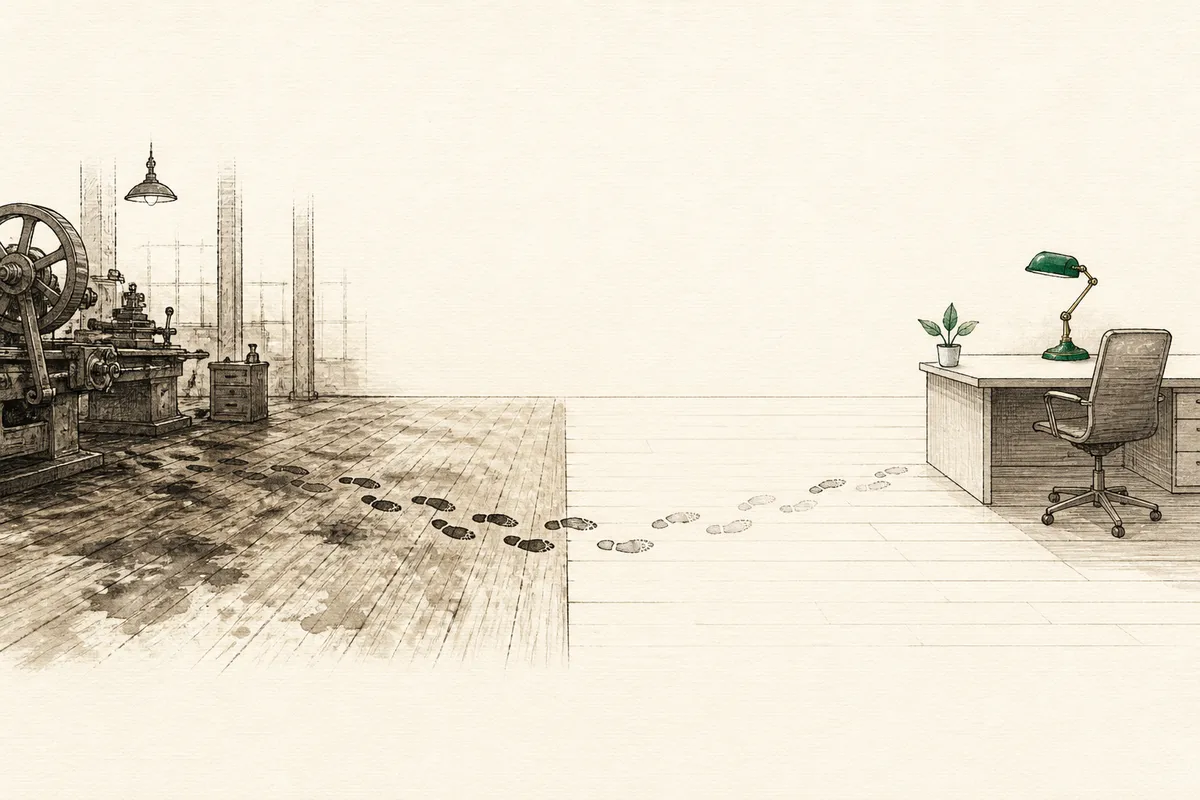
Did Automation Take Jobs, or Just Change Them?
Factory automation didn’t erase work the way the early forecasts assumed it would, it moved work sideways into new categories that didn’t exist before the machines showed up, and that pattern is the closest thing we have to a map for what AI might do next. That’s uncomfortable at first, because it means the question was never really “will jobs disappear.” The better question, the one automation job displacement history actually answers, is which jobs disappear, which ones get reshaped, and which ones get created in places nobody was looking. Understanding that difference matters more right now than it has in decades.
What is automation job displacement history?
Automation job displacement history is the record of how factory jobs actually changed as machines took over specific tasks, showing that total employment didn’t collapse the way early predictions expected but the mix of jobs shifted hard toward maintenance, oversight, and new production roles. It’s not a single event, it’s a decades-long pattern repeated across industries as each wave of mechanization removed certain tasks while creating demand for people who could run, fix, and improve the new equipment. That’s the entire insight worth carrying into any conversation about AI and work. The tasks change before the total job count does.
TL;DR:
Automation job displacement history shows that factory automation rarely eliminated jobs outright, it eliminated specific tasks within jobs while shifting workers toward oversight, maintenance, and new roles that didn’t exist before the machines arrived. Total employment in manufacturing regions often held steadier than predicted, even as the nature of the work changed completely. That’s the pattern worth studying before assuming AI will behave any differently.
Key Takeaways
- Automation job displacement history shows task elimination, not job elimination, as the dominant pattern across factory mechanization.
- Workers displaced from one task frequently moved into adjacent roles tied to operating or maintaining the new equipment.
- The disruption wasn’t painless, certain roles and certain workers absorbed real, concentrated harm even as aggregate numbers looked stable.
- New job categories tied to automation itself, like machine maintenance and quality oversight, didn’t exist before the technology arrived.
- The lesson for AI isn’t that jobs are safe, it’s that the shape of work changes faster than the headcount does.
The Pattern Nobody Predicted Correctly
Here’s the honest version of what happened when factories mechanized. Economists and labor officials in earlier decades forecast mass, permanent unemployment as machines took over repetitive physical tasks, and that forecast was wrong in its scale even though it was right in its direction, because the tasks did disappear while the jobs mostly didn’t. Workers moved, industries reshaped themselves, and entire new occupational categories formed around keeping the automated systems running. That’s the trap in most predictions about technology and work: they assume the job is one indivisible thing, when really it’s a bundle of tasks that can be separated and reassigned one piece at a time.
Automation rarely deletes an entire occupation in one motion, it strips out the most repeatable tasks first and leaves the rest of the job to be redefined around what’s left.
Here’s the real question buried in that history. If a job is really just a bundle of tasks, which tasks inside your own work are repeatable enough to automate, and which ones depend on judgment that doesn’t compress into a rule. That distinction is what determined who thrived and who struggled during the factory automation era, and it’s the same distinction playing out now with AI tools taking over drafting, scheduling, and first-pass analysis work.
Where the Real Damage Landed
The damage from factory automation wasn’t evenly spread, and pretending otherwise flattens a history that deserves more honesty than that. Specific regions built around a single dominant industry absorbed concentrated, lasting harm, because when the task-level automation hit, there weren’t adjacent roles nearby for displaced workers to shift into. That’s the part of the story that gets lost when people cite aggregate employment numbers as proof automation was harmless. Aggregate numbers hide local devastation the same way an average hides a range.
The absence of a complaint gets mistaken for the absence of a problem, and nowhere is that clearer than in regions where automation hollowed out a local economy while national statistics stayed calm.
That’s the honest version, not a hypothetical or a sales pitch dressed up as math. Automation’s costs were real, concentrated, and unevenly distributed, even while its benefits were broad and diffuse. Anyone drawing lessons from this history for AI needs to hold both facts at once instead of picking whichever one supports the conclusion they already wanted.
How Automation Actually Changed the Nature of Work
Automation didn’t just remove tasks, it changed what skill even meant inside a factory, shifting demand away from manual dexterity and toward monitoring, troubleshooting, and process judgment. Workers who adapted weren’t necessarily the most skilled under the old definition, they were the ones who could learn to read a new kind of signal, whether that meant a gauge, a control panel, or eventually a screen. That’s a different kind of literacy than the one the job used to require, and building it took time, training, and often a level of institutional support that wasn’t always there.
| Factory Automation Era | Current AI Wave |
|---|---|
| Removed repetitive physical tasks | Removes repetitive cognitive and drafting tasks |
| Created maintenance and oversight roles | Creating prompt design and output review roles |
| Skill shift toward monitoring machines | Skill shift toward judging AI output |
| Regional concentration of job loss | Occupational concentration of job loss |
| Decades-long transition | Compressed, faster transition |
That table isn’t a perfect map, no historical analogy ever is, but the structural similarity is strong enough to be useful. Both waves separate the mechanical parts of a task from the judgment parts, and both reward the workers who move fastest toward the judgment side.
Documenting Before Automating
Clarifying before scaling was never optional during the factory automation transition, even though most companies treated it that way at the time. Plants that documented their processes before installing new equipment adapted faster, because they understood which tasks were genuinely repeatable and which ones only looked repeatable from a distance. Plants that skipped that step often automated the wrong things, locking in inefficiency at a larger scale instead of removing it. That mistake is easy to repeat with AI tools right now, since the temptation to automate a process nobody has actually mapped out is just as strong today as it was on a factory floor decades ago.
I’ve spent enough time cleaning up messes like that to know the pattern repeats itself almost exactly. A task gets automated before anyone writes down what the task actually involved, and the gaps only surface once something breaks in a way the new system can’t handle. That’s worth running your own version of this math before assuming a tool will fix a process you haven’t actually clarified yet.
Why Some Roles Survived Automation Better Than Others
Roles built around judgment, exception handling, and relationship management survived factory automation better than roles built around repeatable physical steps, because machines could replicate the steps but not the discretion. Supervisors, quality inspectors, and maintenance technicians all saw their jobs reshaped rather than eliminated, since their value was tied to handling the situations a machine couldn’t reliably classify on its own. That pattern holds a warning and a reassurance at the same time. The judgment layer of work has consistently outlasted the mechanical layer.
Staying level when the pressure is real was, and still is, the actual differentiator between roles that got automated away and roles that got absorbed into the new system. Nobody sees the judgment layer of a job directly, they just notice whether the operation feels steady or not when something unexpected happens. That steadiness quietly doesn’t show up as revenue on any spreadsheet, but it shows up everywhere else, in fewer errors, fewer breakdowns, and fewer moments where a customer or a supervisor has to step in and fix something by hand.
Fun Fact
Assembly line mechanization in the early twentieth century didn’t just change factory work, it created entirely new categories of technical and supervisory jobs that hadn’t existed in the prior generation, a pattern that repeated with computer numerical control machining decades later and appears to be repeating again now with AI-assisted production planning.
Field Note
Systems thinking, the discipline of analyzing a process as a set of interdependent parts rather than isolated steps, explains why factory automation reshaped jobs instead of erasing them outright. A system built from many small, interconnected tasks doesn’t collapse when one task gets automated, it redistributes load onto the remaining human-held parts of the process, sometimes awkwardly at first, until the system finds a new equilibrium. That redistribution is exactly what shows up across the historical record of factory automation, and it’s the same lens worth applying to any AI rollout happening inside a business today. Map the system before changing one part of it, or the redistribution happens blindly instead of on purpose.
FAQs
Did automation actually reduce total employment in factories?
No, aggregate factory employment did not collapse the way early twentieth-century predictions expected, even though individual tasks and some entire roles were eliminated. Total job counts in many manufacturing regions held closer to stable than forecasters assumed, largely because new roles tied to operating, maintaining, and improving automated equipment absorbed workers displaced from the older manual tasks. The transition was uneven and often slow, but it wasn’t the wholesale disappearance of work that the strongest predictions warned about.
What jobs were created by factory automation?
Factory automation created maintenance technician roles, quality control and inspection positions, and supervisory roles focused on monitoring automated systems rather than performing manual tasks directly. These jobs required a different skill set than the roles they replaced, centered on reading signals from equipment, diagnosing malfunctions, and making judgment calls the machines couldn’t make themselves. None of these categories existed in the same form before mechanization forced the redesign of the work.
How is AI different from factory automation?
AI differs from factory automation mainly in speed and scope, since it targets cognitive and administrative tasks across nearly every industry simultaneously rather than physical tasks concentrated in manufacturing. Factory automation unfolded over multiple decades, giving regions and workers time, however imperfect, to adapt. AI’s rollout is compressed into a much shorter window, which raises the stakes on getting the adaptation right the first time instead of relying on decades of trial and error.
Will AI eliminate jobs the way automation eliminated factory jobs?
AI is more likely to eliminate specific tasks within jobs than to eliminate entire job categories outright, following the same structural pattern that factory automation followed decades earlier. Roles built heavily around repeatable, rule-based tasks face the most direct pressure, while roles built around judgment, exception handling, and relationship management are more likely to be reshaped than removed. The historical precedent doesn’t guarantee a painless transition, it just clarifies where the pressure is most likely to land.
What can businesses learn from automation job displacement history before adopting AI?
Businesses can learn that documenting a process thoroughly before automating it prevents locking in inefficiency at a larger scale, a mistake that plagued factories that automated processes nobody had actually mapped out. Clarifying which tasks are genuinely repeatable, versus which only look repeatable from a distance, determines whether automation strengthens a workflow or breaks it in ways that surface later. That clarity step matters just as much for AI adoption now as it did for factory equipment decades ago.
Which industries were hit hardest by factory automation?
Manufacturing regions built around a single dominant industry absorbed the most concentrated and lasting damage from factory automation, since displaced workers had few adjacent roles nearby to shift into. Diversified regional economies adapted more easily, because workers had more paths available when specific tasks got automated away. That concentration pattern is a useful warning for any single-industry region watching AI adoption accelerate today.
How long did it take workers to adapt to factory automation?
Worker adaptation to factory automation typically unfolded over years or even decades rather than months, since it required new training, new institutional support, and often a generational turnover in the workforce. That slow timeline gave both workers and institutions room to adjust, even if the adjustment was uneven and left some workers permanently behind. AI’s faster rollout removes much of that built-in adjustment period, which is precisely why documenting and clarifying processes in advance matters more now than it did then.
Next Steps
None of this is a hypothetical exercise, it’s a pattern with enough historical weight behind it to inform a real decision about how a business adopts AI without repeating the mistakes factories made decades ago. If this history is useful context for a decision you’re making, bring it to a discovery call at https://connect.greatlakesbusinesssupport.com/widget/booking/SR4YHWiGhQp2GVlUzQW4.