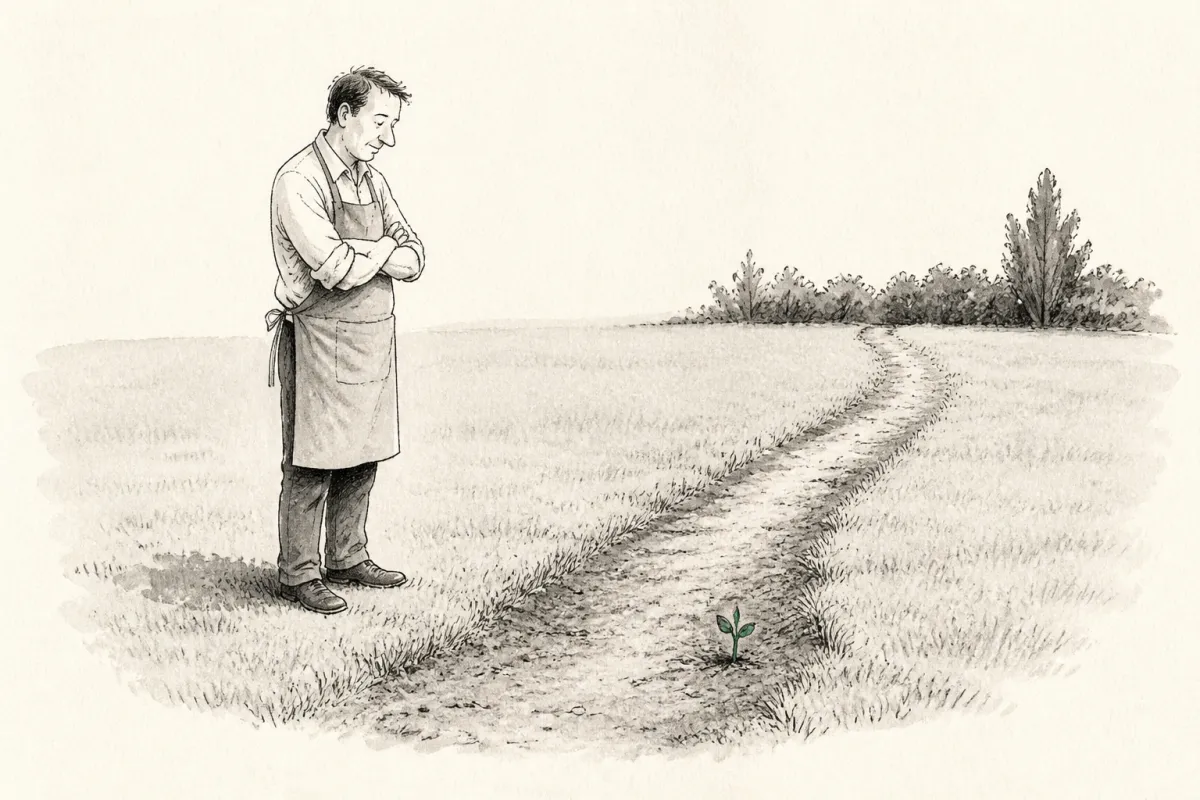
Is Getting Back to Normal Actually a Good Thing?
What does “back to normal vs actually fixed” mean for a small business?
Back to normal vs actually fixed describes the difference between a business that returns to its pre-crisis routine because the owner absorbed the pressure again, and a business that changed how work actually gets done so the same pressure cannot build the same way twice. The first version feels like relief. The second version feels like relief too, at first, which is exactly why so many owners stop looking any closer once the phones calm down and the schedule stops overflowing.
A slow season ends, the backlog clears, the schedule settles, and everyone exhales like the hard part is over, which it might be, except that the exhale is doing a lot of work it hasn’t earned yet. That’s the pattern worth sitting with for a minute before calling it a win. Normal was never a neutral baseline sitting there waiting to be restored, it was a specific arrangement of who covered what, who remembered which client wanted which thing, who stayed late so nothing slipped, and if that arrangement depended entirely on the owner absorbing the gap between what the business needed and what the systems could actually deliver, then getting back to it just means the gap is still there, quietly waiting for the next busy stretch to expose it again.
Here’s the honest version. Relief is real and worth feeling, but relief is a feeling about pressure easing, not a measurement of whether the underlying structure changed at all, and those two things get confused constantly because they arrive at the same moment.
Why does relief get mistaken for a fix?
Relief gets mistaken for a fix because both produce the same immediate symptom, which is the disappearance of visible strain, even though only one of them addresses the reason the strain built up in the first place. When the calls stop piling up and the calendar stops overbooking, the felt experience is identical whether the business documented a process that prevents the pileup or whether the owner simply worked longer hours until the pileup cleared on its own.
That’s the trap. Nobody sees the mechanism underneath a calm week. They just notice whether it feels steady or not, and a business that got calm because the owner absorbed six weeks of unsustainable effort feels exactly as calm, from the outside and even from the owner’s own exhausted vantage point, as a business that got calm because a new intake process actually removed the bottleneck.
The absence of a complaint gets mistaken for the absence of a problem, and that mistake is what lets owner-dependent structures survive one busy season after another without ever being examined.
That’s the entire insight, really. The test isn’t whether things feel fine right now, the test is what would happen the next time volume spikes, because if the answer is still “the owner would have to grind through it again,” then nothing was fixed, something was just weathered.
Documenting before automating, clarifying before scaling
Documenting before automating means writing down how a process actually works, step by step, before trying to speed it up or hand it off, because automating a process nobody can explain just automates the confusion faster. Clarifying before scaling means the same principle applied to growth, where adding volume onto an unclear structure multiplies the strain instead of the output.
A lot of owners reach for tools or hires as the fix for a rough season, when the actual gap is that no one, including the owner, could fully describe how the busy period was supposed to be handled. That’s uncomfortable at first. Nobody wants to admit the process running their business mostly lives in their own head, adjusted on the fly, remembered rather than recorded.
- A documented process survives someone being on vacation.
- An undocumented process survives only as long as the owner is available to patch it live.
- Clarifying what a task actually requires exposes whether it needs a person, a tool, or just a clearer handoff.
- Scaling on top of an unclear process just produces a bigger version of the same strain.
That’s the honest version again, stated plainer. Get the process written down and understood before deciding whether to speed it up, because speed applied to confusion just produces confusion at a higher volume.
Back to normal vs actually fixed: a side by side
| Signal | Back to normal | Actually fixed |
|---|---|---|
| Who absorbed the pressure | The owner, through longer hours and personal effort | A documented process or a delegated role |
| What changes next busy season | Nothing, the same strain returns | The system handles more volume without the same strain |
| How it feels right after | Relief, calm, exhaustion fading | Relief, calm, plus a clear answer for what changed |
| What happens if the owner is unavailable | The gap reappears immediately | The process holds regardless |
| Where the cost shows up | Quietly, in owner burnout and missed growth | Nowhere new, because it was addressed at the root |
Here’s the real question underneath that table. Not whether the business feels calm today, but whether the calm would survive the owner stepping away for two weeks, because that’s the actual measure of whether something structural changed or whether the owner just absorbed the difference one more time.
Why owner-dependent structures cost more than they show
Owner-dependent structures cost more than they show because the price gets paid in personal capacity rather than in a line item, which means it never appears on a profit and loss statement even though it directly limits how much the business can grow. A structure that only works because one person is willing to fill every gap has a hard ceiling built into it, and that ceiling has nothing to do with market demand or marketing spend.
A business that quietly depends on one person absorbing every gap in the system quietly doesn’t show up as revenue lost, it shows up as growth that never happens.
That’s the part that’s easy to miss, because nothing about it looks like a problem in the moment. The owner just works a little harder, answers a few more calls personally, stays a little later, and the business survives the stretch, and survival gets recorded as success even though the actual cost was a ceiling nobody named out loud.
This isn’t a hypothetical or a sales pitch dressed up as math, it’s a fairly plain accounting of where effort goes when a business has no repeatable answer for pressure other than the owner staying level when the pressure is real. Staying level is a real skill and it matters, but it is not a substitute for a system, and treating it as one is how the same summer strain returns every single year with a different calendar date attached to it.
Fun Fact
Organizational theory has a specific term for a business whose processes exist only in one person’s head rather than in any documented or transferable form, sometimes called tribal knowledge, and the risk it describes is not hypothetical, it is one of the most commonly cited reasons small businesses stall at a certain size regardless of how strong demand for their product or service actually is.
Field Note
Systems thinking, as a general management framework, distinguishes between a symptom and a root cause by asking whether the same input would still produce the same undesirable output if repeated under identical conditions. Applied here, the useful question is not whether the busy season ended calmly, but whether an identical busy season next year, with the same volume and the same team, would produce the same strain or a different one. If the honest answer is the same strain, the system has not changed, only the calendar has. That distinction, treating calm as a symptom rather than a conclusion, is the core discipline behind most operational improvement work, regardless of industry or company size.
FAQs
How do I know if my business is actually fixed or just back to normal?
The clearest test is whether the same volume spike could happen again without requiring the owner to personally absorb the gap the way they did last time. If the honest answer involves the owner working longer hours, answering more calls personally, or mentally tracking more details than usual, the structure hasn’t changed, only the immediate pressure has passed.
What is owner dependency in a small business?
Owner dependency is a business structure where critical decisions, client relationships, or process knowledge exist only with the owner rather than being documented or shared across the team. It means the business’s capacity is capped at whatever the owner can personally handle, regardless of how much demand exists.
Why does a calm period not always mean a problem is solved?
A calm period only proves that visible strain has stopped, not that its underlying cause was addressed. Businesses can reach calm either by fixing the process that caused the strain or by the owner temporarily working harder to cover the gap, and both produce the identical feeling of relief.
How do I document a process before trying to automate it?
Start by writing down every step of the task exactly as it currently happens, including the judgment calls the owner makes without realizing it, before touching any tool or software. A process that cannot be clearly explained in writing is not ready to be automated, because automation will just replicate the confusion at a faster pace.
What is the difference between documenting and automating a process?
Documenting a process means writing out how a task is actually performed, step by step, so anyone could follow it without guessing. Automating a process means using a tool or software to perform some of those steps without a person doing them manually, which only works well once the steps themselves are clear.
Why do owners feel relieved even when nothing structurally changed?
Relief is a response to reduced pressure, not a measurement of whether the pressure’s source was removed. An owner who worked through a hard stretch and made it to the other side feels the same physical and emotional relief whether the business changed its systems or whether the owner simply outlasted the strain through personal effort.
What questions should I ask before scaling my business further?
Ask whether the current process for handling normal workload is written down, understood by more than one person, and able to hold up if the owner were unavailable for two weeks. If those answers are unclear, it’s worth clarifying the process itself before adding more volume on top of it, since scaling an unclear system just produces a larger version of the same strain.
Next Steps
It’s worth running your own version of this math before the next busy season arrives and the same pattern repeats itself under a different name. I’ve spent enough time cleaning up messes like that to know the fix rarely starts with a new tool, it starts with an honest look at what the business actually depends on to stay level. If it would help to talk through where the dependency sits in your operation, you can talk it through with a discovery call.