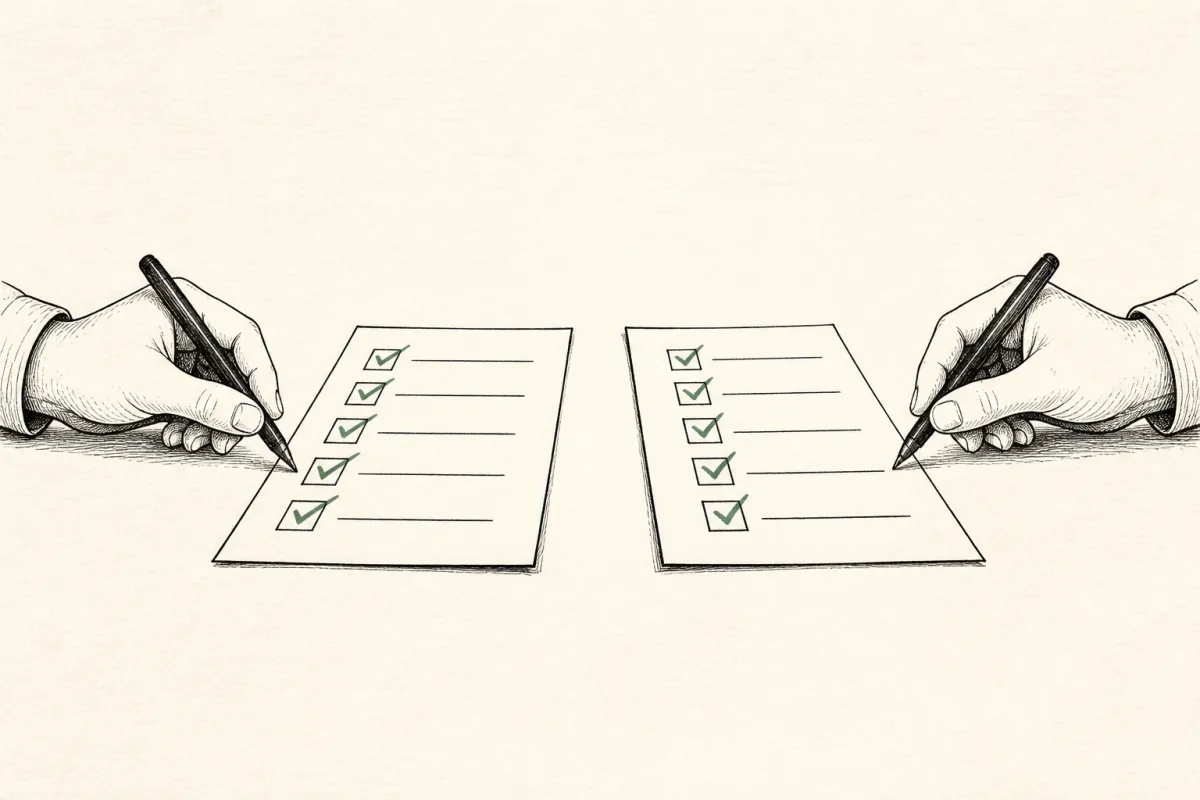
How Long Until a Documented Process Pays for Itself?
TL;DR:
Documented process payback time isn’t measured in weeks or a percentage of hours saved, it arrives the first moment someone other than the owner runs the process correctly without stopping to ask a question. That single event, small as it looks, is the actual return on the documentation effort, and everything before it was just setup cost. Waiting for a spreadsheet to confirm the payoff misses the point entirely, because the confirmation already happened the moment the process held up without you.
Key Takeaways
- Documented process payback time happens at a specific moment, not over a calculated period, and that moment is the first clean, unassisted, correct run by someone other than the owner.
- A process that only works when the owner is nearby to answer questions was never actually documented, it was just narrated once and forgotten.
- The absence of a complaint gets mistaken for the absence of a problem, which is why so many undocumented processes look fine right up until they aren’t.
- Documenting before automating matters because automation locks in whatever the process actually is, mistakes included, so clarity has to come first.
- ROI math on documentation tends to undersell it, because the real value quietly doesn’t show up as revenue, it shows up as the owner not getting a phone call.
- It’s worth running your own version of this math on at least one process this month, using the moment of first correct independent execution as the marker, not a percentage.
What Is Documented Process Payback Time?
Documented process payback time is the point at which a written process starts producing value on its own, measured by the first instance someone other than the person who wrote it follows it correctly without needing clarification. It isn’t a ratio of hours invested against hours saved, and it isn’t something a spreadsheet formula captures cleanly. It’s an event. A specific run, on a specific day, where the process held up without the owner in the room. That’s the whole definition, and it’s simpler than most people expect it to be.
Here’s the honest version of why this matters. Most owners treat documentation like insurance, something you buy and hope never has to prove itself, and they judge its value the way they’d judge a savings account, by watching a number grow slowly over time. That’s the wrong frame entirely. A documented process doesn’t accumulate value the way interest does, it either works the first time it’s tested by someone new or it doesn’t, and that test usually comes faster than owners expect.
Why the Spreadsheet Version of ROI Misses the Point
Calculating ROI on documentation as a percentage of time saved treats the value as gradual and cumulative, when the actual payoff is binary and immediate, arriving fully formed the first time the process survives contact with someone other than its author. A spreadsheet wants inputs. Hours spent writing the process, hours saved per week, a break-even date circled in a projection. That math isn’t wrong exactly, it’s just answering a question nobody asked.
The real question isn’t how many hours a documented process saves over a quarter, it’s whether the process holds up the very first time it’s handed to someone else. That’s the test. Not a hypothetical or a sales pitch dressed up as math, just a plain observation about how trust in a system actually gets built. If a new hire, a part time helper, or a family member covering for a day can follow the steps and land in the right place, the documentation already paid for itself. If they can’t, no amount of projected time savings changes that outcome.
A documented process either survives its first handoff or it doesn’t, and that single moment is worth more than any percentage calculated after the fact.
What Actually Happens the First Time Someone Else Runs It
Here’s the trap that catches a lot of owners off guard. They write something down, feel a sense of relief, and assume the hard part is finished. It isn’t. The hard part is watching, or more often not watching, what happens when someone else picks it up cold. That’s uncomfortable at first. Owners who’ve built a process in their head for years, refined it without ever writing a word of it down, tend to flinch when someone else’s version of “correct” looks slightly different from theirs.
That flinch is useful information though, because it usually means the original process was never as clear as it felt. Clarifying before scaling means catching that gap before it gets baked into a hiring plan, a new location, or a piece of automation. When the documented version actually gets followed correctly on the first try, without a call, a text, or a hallway question, that’s the signal. Not a good signal. The signal.
The moment a process survives without the owner nearby is the moment the documentation stops being a task and starts being an asset.
How Long Does It Actually Take?
In most cases the payback arrives the very next time the process runs, meaning the timeline isn’t weeks or months, it’s simply the next occurrence of the task after it’s been written down clearly enough for someone else to follow. That’s a much shorter window than owners tend to expect, and it’s also a much more useful one, because it turns the question from a financial projection into an observable event.
A few patterns show up consistently:
- Simple, single-owner tasks (opening procedures, basic intake steps, routine scheduling) tend to pay back on the very first handoff, because there’s little room for interpretation once it’s written clearly.
- Multi-step processes with judgment calls built in (client onboarding, quoting, quality checks) sometimes take two or three runs, since the first attempt surfaces gaps the writer didn’t know were there.
- Processes that depend on tribal knowledge nobody wrote down before take the longest, not because documentation is slow, but because the underlying process was never actually clear even to the owner.
That’s the entire insight. The timeline isn’t fixed by a formula, it’s fixed by how much of the process was already clear in the owner’s head before it got written down.
Documenting vs. Automating: Which Comes First
| Question | Documenting First | Automating First |
|---|---|---|
| What gets locked in | The actual correct steps, reviewed and clarified | Whatever the current process happens to be, mistakes included |
| Who can catch errors | A person reading it, before it’s ever run automatically | Nobody, until the automation produces a wrong result downstream |
| Cost of a mistake | Low, caught in a read-through or a first test run | Higher, since automation repeats the mistake at scale immediately |
| Speed to payback | Fast, often the very next process run | Slower, since flaws surface only after the automation is live |
Documenting before automating isn’t a preference, it’s a sequencing problem. Automation is extremely good at repeating exactly what you tell it to do, including the parts that were never actually correct. A written process gives someone a chance to catch that before it gets locked into a workflow tool that runs the same mistake a thousand times without complaint.
Why the Absence of Complaints Fools Owners
The absence of a complaint gets mistaken for the absence of a problem more often than most owners would admit. A process that’s never been written down can run for years without anyone flagging an issue, not because it’s flawless, but because the one person running it has quietly absorbed every inconsistency into memory. Nobody sees the workaround, the mental note, the “oh right, except when.” They just notice whether the business feels steady or not.
That’s the part that quietly doesn’t show up as revenue. A process staying level when the pressure is real, when the owner is out sick or slammed with something else, isn’t something a customer notices directly. They just notice whether service still feels steady or falls apart. Documentation is what makes that steadiness possible without the owner physically present to hold it together.
Fun Fact
The idea of writing down a process so it survives without its original creator traces back to industrial engineering practices from the early 20th century, where standardized work instructions were developed specifically so a task could be performed consistently by any trained worker, not just the person who invented the method.
Field Note
Systems thinking, a framework widely used in operations and quality management, treats a business as a set of interconnected processes rather than a collection of individual efforts. Under that framework, a process only counts as a system once it’s independent of any single person’s memory or presence, meaning it can be observed, followed, and improved by someone who didn’t create it. Documentation is the mechanism that turns an owner’s habit into a system in that sense. Without it, what looks like a process is really just one person’s routine, and routines don’t transfer, they just get reenacted imperfectly by whoever’s watching closely enough to guess at the missing steps.
FAQs
How long does it take for a documented process to pay off?
Documented process payback time typically arrives the very next time the process runs, specifically the first time someone other than the owner completes it correctly without needing to ask a question. It isn’t a multi-week or multi-month timeline in most cases. Simple tasks pay back almost immediately, while processes involving judgment calls might take a run or two to fully hold up, but the marker is always the same, a clean independent execution.
What is a documented process?
A documented process is a written, step by step account of how a task gets done correctly, detailed enough that someone unfamiliar with it can follow it without needing the original creator’s help. It’s different from a checklist or a rough set of notes, because a true documented process anticipates the judgment calls, exceptions, and edge cases that come up, not just the ideal-case steps.
Why do documented processes get skipped by small business owners?
Documented processes often get skipped because writing them down takes visible time up front while the cost of not writing them down stays invisible until something goes wrong. Owners who’ve run a task the same way for years often don’t realize how much of it lives only in their head, since nothing has forced that knowledge into writing yet. That’s the trap, the absence of a problem so far gets read as proof none is coming.
Does documenting a process really save time, or is that overstated?
Documenting a process genuinely saves time, but the savings show up as fewer interruptions and fewer errors rather than as a clean number on a report. The time saved is the phone call the owner doesn’t get, the mistake that doesn’t happen, the training conversation that doesn’t need repeating. That’s real value, it just quietly doesn’t show up as revenue, which is exactly why it gets undercounted.
Should I document a process before I automate it?
Yes, documenting before automating is the correct order almost every time, because automation locks in whatever the process actually is, including any mistakes that were never caught. Writing the process down first gives someone a chance to review it, clarify the fuzzy parts, and confirm it produces the right result before it gets built into a tool that will repeat it exactly, correct or not.
What’s the difference between a documented process and a habit?
A documented process is written down and transferable, while a habit lives only in the routine of the person performing it and disappears the moment that person is unavailable. A habit can look identical to a process from the outside, right up until the person holding it in their head takes a day off, changes roles, or leaves entirely, at which point the gap becomes obvious fast.
How do I know if a process is actually well documented?
A process is well documented when someone unfamiliar with it can complete it correctly on the first attempt without stopping to ask a clarifying question. That’s the test, and it’s a simple one. If new hires or backup staff keep needing to check in partway through, the documentation still has gaps, even if it looks thorough on paper.
Next Steps
Worth running your own version of this math on at least one process this week, picking whichever task causes the most quiet friction when the owner isn’t around to handle it personally. Start documenting with a Free Website & Workflow Review at https://www.greatlakesbusinesssupport.com/free-website-workflow-review. That’s the entire insight, tested against your own operation instead of a hypothetical one.