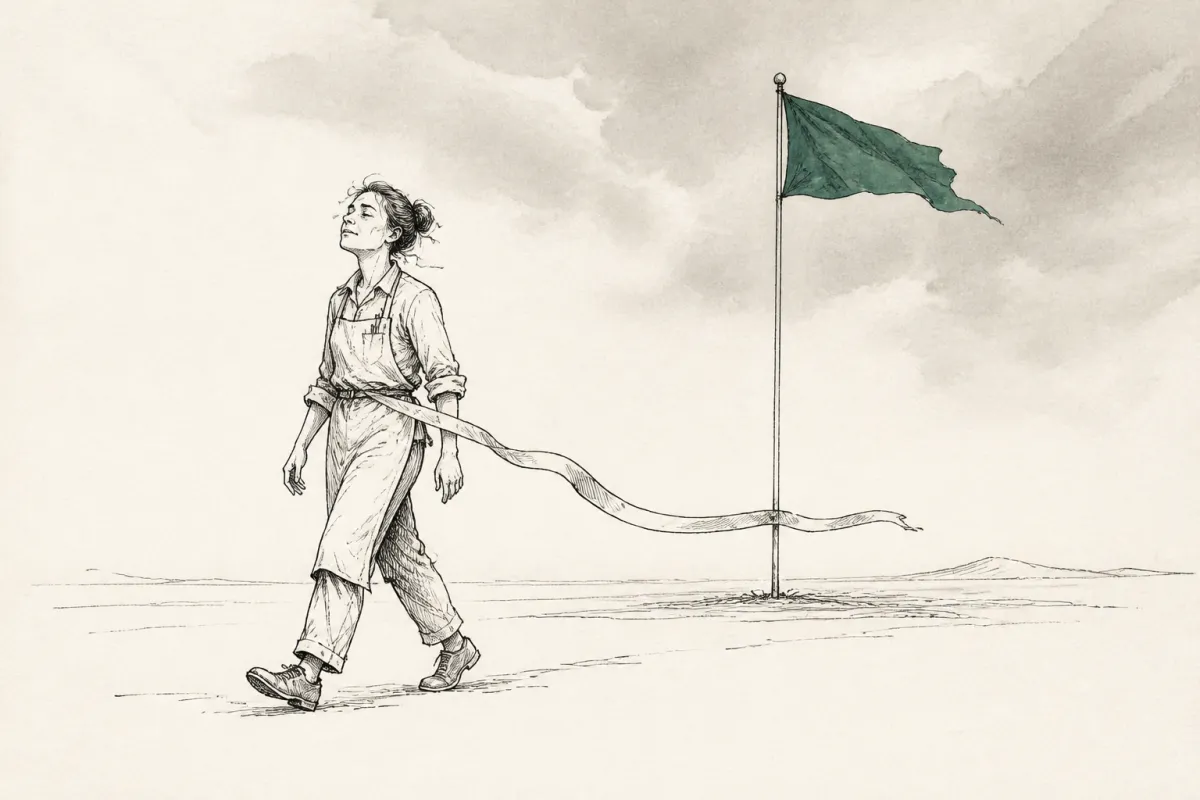
Why Do You Feel Behind Even After Surviving Summer?
What does it mean to feel behind after a busy season?
Feeling behind after a busy season means the business made it through a high-pressure stretch without collapsing, but nothing that caused the strain in the first place actually got fixed, so the pressure just resets to zero and waits for next year. That’s the entire insight. Survival and resolution get treated like the same outcome because the calendar moved on and the phones stopped ringing off the hook, but one of those outcomes reduces next season’s stress and the other one doesn’t touch it at all.
A business can run through its busiest months, hit every deadline, keep every customer, and still come out the other side carrying the exact same structural weak points it walked in with. That’s uncomfortable at first. Here’s the honest version: getting through summer proves the team can absorb pain, not that the pain had a cause worth naming. Those are different skills, and only one of them compounds in your favor.
Why surviving a busy season doesn’t reduce next year’s stress
Surviving a busy season doesn’t reduce next year’s stress because survival is a measure of endurance under pressure, while stress reduction requires identifying and removing the specific conditions that created the pressure, and enduring something does nothing to remove it. A team can grit through a chaotic quarter using overtime, improvisation, and sheer willpower, and every one of those things disappears the moment the busy season ends, taking the lesson with them.
Here’s the trap: the absence of a complaint gets mistaken for the absence of a problem. Nobody complained loudly enough to trigger a fix, so the assumption becomes that nothing needed fixing, when really the team was just too depleted to flag it or too used to the chaos to think it was avoidable. That gap, between what actually got resolved and what merely survived, quietly doesn’t show up as revenue. It shows up next year, on the same week, in the same way.
Surviving a busy season proves a team can endure pressure. It does not prove the pressure had a cause worth naming.
Surviving vs. resolving, what’s the actual difference
The difference between surviving and resolving is not a matter of degree, it’s a matter of category, and confusing the two is how businesses end up dreading the same month every single year without ever being able to say exactly why.
| Surviving | Resolving |
|---|---|
| Team absorbs the pressure through extra hours and effort | Root cause of the pressure gets identified and removed |
| Relies on individual willpower and improvisation | Relies on a documented process anyone can follow |
| Resets to zero once the busy season ends | Compounds, each season gets easier than the last |
| Success measured by “we made it” | Success measured by “that specific problem won’t recur” |
| Depends on the same people being available again | Works even if key people are out or new |
That table isn’t a hypothetical or a sales pitch dressed up as math. It’s a plain description of two outcomes that get talked about as if they’re interchangeable, when only one of them actually lowers the ceiling on how bad next year’s version of the same stretch has to be.
Why the busy season always feels like it’s repeating
The busy season feels like it’s repeating because the underlying causes, whether that’s understaffing, unclear intake processes, or no documented handoff between roles, were never actually named or addressed, so the same conditions simply wait for the same calendar dates to reappear. A business can change owners, add staff, buy new software, and still hit the identical wall in July or August, because none of those changes touched the actual mechanism that made the strain happen in the first place.
Here’s the real question worth asking once things calm down: what specifically got hard, and why did it get hard, not just that it did. Naming the mechanism matters more than naming the symptom. A few common mechanisms behind repeat seasonal strain:
- No documented process for the tasks that spike in volume, so every busy season relearns the same lessons from scratch.
- Owner dependency, where decisions or approvals bottleneck through one person who becomes the ceiling on how much the business can absorb.
- Unclear handoffs between roles, meaning work stalls whenever someone is out or overloaded.
- No system for triaging what’s urgent versus what can wait, so everything gets treated as equally urgent.
- Staffing that scales for the average week instead of the peak week.
Clarifying before scaling matters here, because adding more people or more tools onto an undocumented process just multiplies the same confusion at a higher volume. Documenting before automating matters for the same reason. An automated version of a broken process is still a broken process, just faster.
How do you know if you actually resolved something or just survived it
You know something was resolved, rather than merely survived, if the specific condition that caused the strain can be pointed to directly and has since been changed, removed, or documented, versus simply hoping the same people show up with the same energy next time. If the honest answer to “what did we do differently” is “we worked harder,” that’s survival. If the answer names a process, a role, or a bottleneck that no longer exists in the same form, that’s resolution.
The absence of a complaint gets mistaken for the absence of a problem far more often than either owners or teams want to admit.
A useful test: imagine the busiest week of the season happening again next month, with no warning. If the honest reaction is dread, nothing got resolved. If the reaction is closer to “we know what to do differently now,” something did.
Fun Fact
The word “resolve” comes from the Latin resolvere, meaning to loosen or untie, which is a fittingly literal description of what actually needs to happen to a bottleneck versus simply pushing harder against it until the season ends.
Field Note
Systems thinking, a concept most associated with organizational theorist and engineer W. Edwards Deming, draws a hard distinction between a problem caused by a person and a problem caused by a process, arguing that the vast majority of operational failures trace back to the process, not the individual working inside it. Applied here, that framing explains why “the team pulled through” and “the problem is fixed” get treated as equivalent when they’re not even measuring the same thing. One measures the people. The other measures the system those people were forced to operate inside. Staying level when the pressure is real says something good about the team. It says nothing about whether the system that created the pressure still exists exactly as it did before.
FAQs
Why do I feel behind after getting through the busy season?
You feel behind because getting through a busy season measures endurance, not resolution, and the specific conditions that made it stressful are very likely still fully intact even though the calendar has moved on. That feeling is your read on the actual state of the business, not a false alarm. It’s worth treating it as information rather than as something to push past.
Is it normal to dread the same busy season every year?
Yes, it’s common when the root causes of a busy season’s strain were never identified or changed between one cycle and the next. Dread in this context usually isn’t emotional overreaction, it’s an accurate signal that the same unresolved conditions are still sitting there waiting for the same calendar dates.
What’s the difference between surviving a busy season and fixing what caused it?
Surviving means the team absorbed the pressure through extra effort and got through it, while fixing means the specific condition that created the pressure was identified and changed so it won’t recur in the same form. Only the second one actually reduces stress the next time around, because the first one resets to zero the moment the busy season ends.
How do I find out what actually caused the strain?
Start by naming the specific moments that felt hardest, not the general sense that “it was a lot,” and ask what mechanism, not what person, was behind each one. Common culprits include undocumented processes, one person acting as a bottleneck for decisions, or unclear handoffs between roles. Naming the mechanism is the entire difference between a vague postmortem and one that actually changes next year.
Does hiring more people fix a repeating busy season problem?
Not by itself, because adding people to an undocumented or unclear process usually just multiplies the existing confusion rather than removing it. Clarifying the process before scaling the team tends to produce a more durable fix than staffing alone.
What should I actually do once the busy season ends?
The most useful step is a plain accounting of what got hard and why, documented while the details are still fresh rather than months later once things have gone quiet again. Documenting before automating and clarifying before scaling both start from that same accounting. Skipping it is how the same strain reappears on the same dates next year.
Can a business feel behind even if revenue and customer numbers were fine?
Yes, because feeling behind is a read on internal process health, not on external results, and a business can hit every number while still running on improvisation that quietly doesn’t show up as revenue until it eventually breaks something. Good numbers can mask an unresolved process for a surprisingly long time.
Next Steps
Here’s the honest version of where most of this lands: naming what actually caused the strain, rather than just noting that the team pulled through it, is the part that changes next year’s version of the same season. It’s worth running your own version of this math before the next busy stretch arrives, while the details are still specific enough to be useful. I’ve spent enough time cleaning up messes like that to know the fix is rarely more effort, it’s usually more clarity. If it would help to talk through where the actual bottlenecks were this year, you can talk it through with a discovery call.