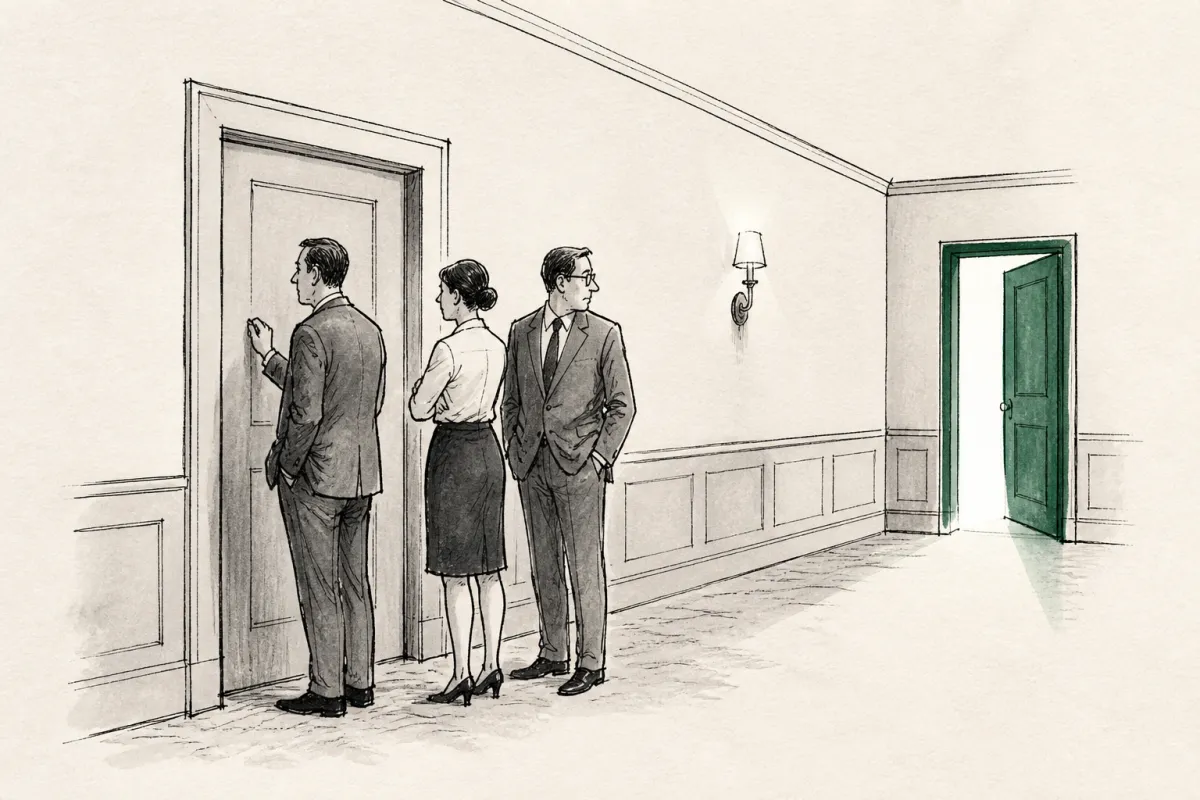
Why Does Your Team Need You for Everything?
A team that reaches for the owner the moment a decision gets even slightly unfamiliar isn’t showing loyalty, it’s showing the absence of a written answer, and those two things get confused constantly because dependence feels like devotion when you’re standing in the middle of it. That’s the trap. Owners read the constant questions as commitment, as a team that cares enough to check, when what’s actually happening is that the answers only exist in one person’s head and everyone else is just routing around that fact the only way they can.
Why does your team need you for everything?
Your team depends on owner input for everything because the decisions that guide daily work were never written down anywhere else, so the owner’s memory becomes the only reference document the business has. That’s not a training gap and it’s not a motivation problem. It’s a documentation gap, and documentation gaps get filled by whoever happens to be standing there with the answer, which in most small businesses is still the owner, every single time.
Here’s the honest version: if you disappeared for two weeks, the questions that would flood in aren’t really questions about competence. They’re requests for a decision that was made once, in your head, and never captured anywhere your team can reach without you. That’s the entire insight. The team depends on the owner too much not because they’re incapable, but because nobody built them a substitute for asking you directly.
What does a team that depends on its owner too much actually mean?
Team depends on the owner too much is a specific operational condition where routine decisions, exceptions, and judgment calls all route back to one person because no other source of truth exists, which quietly caps how much the business can grow without that person’s constant presence. It’s not about hours worked or hovering. It’s about where the knowledge lives. A business can have a hands-off owner and still suffer from this if the knowledge was never transferred out of that owner’s head into something the team can consult on its own.
This distinction matters because it changes what you fix. Train harder and the dependency stays, because training without documentation just teaches people to ask better questions, not fewer of them. Hire more experienced staff and the dependency stays too, because even a sharp new hire still needs to know how this business, specifically, wants things handled. The fix isn’t a personnel change. It’s clarifying before scaling, and documenting before automating anything that depends on a decision nobody’s written down yet.
The complaint that never comes
Here’s the real question worth sitting with: how would you even know if this was a problem, given that nobody’s complaining about it? The absence of a complaint gets mistaken for the absence of a problem constantly, and this is exactly where that mistake lives. Your team isn’t going to walk in and say the business lacks documented decision-making, because most people don’t have language for that. They just know they need to ask you, so they ask you, and the asking looks like normal operations right up until the moment you’re not available and it stops looking normal at all.
The absence of a complaint gets mistaken for the absence of a problem, and owner dependency is where that mistake hides longest.
Nobody sees the missing documentation directly. They just notice whether the business feels steady when the owner steps out of it or not. That feeling, steady versus shaky, is the actual signal, and it’s a lot more reliable than counting how many questions land in your inbox on a given day.
What documentation actually looks like
A documented decision doesn’t need to be a manual with a table of contents. It needs to answer the question the next person will actually ask, in the order they’ll actually ask it, without requiring them to already know the answer to find it. That’s a lower bar than most owners assume, which is good news, because it means the fix is more achievable than it feels from the inside of a business that runs entirely on tribal knowledge.
Some starting points that cover the decisions that generate the most repeat questions:
- Write down the answer the next time someone asks you something for the second time, not the first.
- Keep the format plain. A shared document with dated entries beats a polished manual nobody updates.
- Assign one person to own updates, so the document doesn’t quietly go stale within a quarter.
- Review it against real questions coming in, not against what you assume people need.
- Treat any repeated question as a documentation failure, not a training failure.
That’s the honest version of where to start. Small, current, and actually used beats comprehensive and abandoned every time.
Reframing effort versus clarity
| Approach | What it assumes | What it actually fixes |
|---|---|---|
| More training | Team lacks skill or knowledge | Nothing, if the real gap is a missing reference |
| Closer supervision | Team lacks judgment | Nothing, and it often slows decisions further |
| Hiring more experienced staff | Team lacks experience | Only if the business’s specific decisions are already documented |
| Documenting decisions once made | Nothing, it targets the actual gap | The root cause, directly |
The table makes the pattern obvious. Three of the four common responses to a team depending on the owner-too-much problem addresses a symptom that may not even be present, while only one addresses the actual mechanism causing the dependency in the first place.
Staying level when it’s tempting not to
Here’s the trap that catches owners who’ve already noticed the pattern: once you see how much of the business runs on your memory, the instinct is to grab tighter, to answer faster, to become even more available so nothing slips. That instinct quietly doesn’t show up as revenue anywhere, but it shows up everywhere else, in how tired the owner gets and in how little the team grows into independent judgment over time. Staying level when the pressure is real, and choosing to write the answer down instead of just giving it verbally one more time, is the harder short-term choice and the only one that actually reduces the dependency long term.
That’s the entire insight, restated plainer: every time you answer instead of a document, you’ve solved today’s question and guaranteed tomorrow’s identical one.
Fun Fact
The concept of writing down institutional knowledge before it walks out the door has a formal name in organizational theory: knowledge management, a discipline built around capturing what employees know so it survives turnover, absence, or growth. It exists precisely because verbal-only knowledge transfer has a documented failure point, the moment the person holding it is unavailable.
Field Note
Systems thinking, a framework for understanding how the structure of a process shapes its outcomes rather than the individual effort within it, offers a useful lens here. The framework holds that most recurring problems in an organization trace back to how the system is built, not to the competence of the people working inside it. Applied to owner dependency, this reframes the whole issue cleanly: a team that keeps needing the owner isn’t a team performing badly, it’s a system missing a structural piece, specifically a documented reference that could stand in for the owner’s memory. The fix, under this framework, is never to push harder on the people. It’s to change the structure so the knowledge doesn’t have a single point of failure anymore.
FAQs
How do I know if my team depends on the owner too much?
You’ll know because the same categories of questions keep resurfacing even after you’ve answered them before, and the business noticeably slows or stalls the moment you’re unreachable. Watch for staff hesitating on decisions they’ve technically handled before, or defaulting to “let me check” on things that have a clear precedent. That hesitation is usually a documentation gap wearing the costume of an uncertainty problem.
Why does my team keep asking me the same questions?
Your team keeps asking the same questions because the answer only exists in your memory, so every new instance of that question looks brand new to whoever’s asking, even if you answered an identical version last month. Without a written reference, there’s no way for staff to check their own memory or a colleague’s notes first. Each question routes straight back to you because you’re the only searchable record that exists.
What is the fastest way to reduce owner dependency in a small business?
The fastest way to reduce owner dependency is to document the answer the next time a repeat question comes up, rather than answering it verbally one more time and letting the knowledge stay locked in your head. Start with the three or four questions you answer most often. Write those down first, in plain language, and put them somewhere the team already looks.
Is owner dependency a sign of a weak team?
No, owner dependency is a structural condition, not a measure of team quality, and it appears just as often on strong teams as weak ones because it’s caused by missing documentation rather than missing capability. A capable employee asked to make a decision with no reference point will still have to ask, because guessing on someone else’s business carries real risk they’re right not to take on themselves.
How do I start documenting decisions without slowing everything down?
Document only the decisions that get asked about more than once, and skip anything that’s genuinely a one-time judgment call, since that keeps the process focused and light rather than a separate full-time project. A running shared document, updated in real time as repeat questions arise, works better than a scheduled overhaul that never quite gets prioritized.
Does documenting decisions replace good communication with my team?
No, documentation supports communication rather than replacing it, since a written reference handles the routine and repeatable questions while direct conversation stays reserved for the genuinely new or judgment-heavy situations that deserve real discussion. The goal isn’t to remove the owner from every conversation. It’s to stop the owner from being the only source for questions that already have a known answer.
What happens if I don’t fix owner dependency before I try to scale?
Scaling without fixing owner dependency multiplies the same bottleneck across more people, more locations, or more hours, which means growth actually increases the strain on the owner instead of relieving it. That’s the practical case for clarifying before scaling. Adding headcount onto an undocumented decision structure just adds more people waiting on the same single point of failure.
Next Steps
I’ve spent enough time cleaning up messes like that to know the pattern rarely announces itself early, it just quietly caps growth and drains the owner until something forces the issue. It’s worth running your own version of this math before that happens. If you want to talk through what your team actually needs, and how much of it is really a documentation gap wearing a training-problem disguise, you can book a discovery call and walk through it directly.